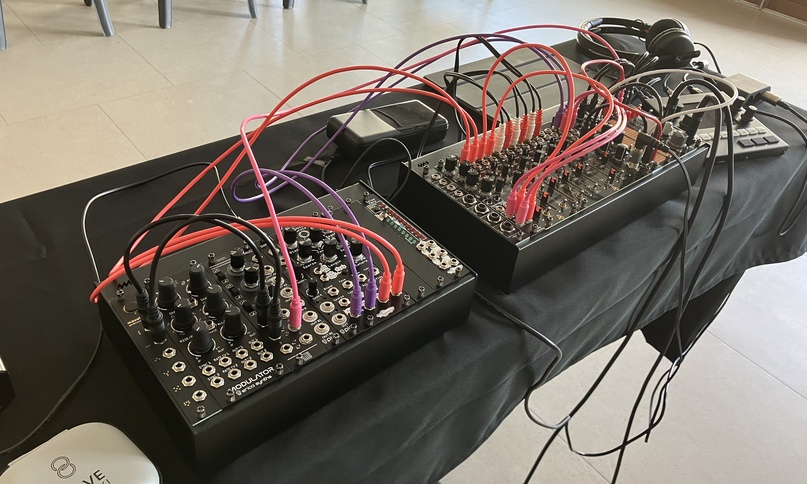
"Generative Music from the Quantum World" by Jean-Claude Heudin

➡️ This presentation is part of IRCAM Forum Workshops Paris / Enghien-les-Bains March 2026
Quantum Music
Quantum theory is a promising source of inspiration for experimental electronic music [1]. In this framework, we have recently introduced the concept of Quantum Notes [2]. A Qunote is a specific musical concept that follows the principles of quantum mechanics: superposition, coherence/decoherence, and entanglement. Qunotes are like Qubits but with musical notes instead of binary information. In a classical composition, a note would have to be in one state, ie. one pitch value, if we consider only this parameter. In contrast, the quantum state of a qunote is represented by a linear superposition of a defined number of pitch values. It’s only when the piece of quantum music is played (measured) that a qunote collapses into a defined state. Each time you play the same qunote, you may obtain different notes depending on the probability amplitudes. This results in many possible interpretations of the same score. As a consequence, when composing, you need to think at all the possible interpretations. You are composing with probability amplitudes instead of fixed notes.
Qunotes are implemented using qubits on a quantum computer. However, publicly available multi-qubit computing resources are very limited. As a consequence, we simulate quantum properties with a set of dedicated algorithms implemented within the Angelia software. Also, we have developed an optical one-qubit device that enables to experiment with real quantum effects. The optical quantum device is based on the KLM protocol [3].
About Angelia
Angelia is an artistic and research project developed since 2017 by Jean-Claude Heudin. Angelia is the contraction of “Angel” and “IA”, the french acronym for Artificial Intelligence. The aim of the project is to enhance the creativity of the artist for composing, and to augment his capabilities when performing. Angelia is a hybrid generative AI [4]. The music is composed using a dedicated high-level programming language which enables to choose for each instruction among different bioinspired algorithms like a Corpus-based Genetic Algorithm, Cellular Automata, among many others [5].
Most AI music systems generate music with no feedback from the produced sounds. In parallel with the generation, Angelia analyzes the produced music in order to generate stimuli that update an “emotional metabolism”. The resulting emotional state influences parameters that modify the expressiveness of the interpretation. This emotional metabolism is inspired by our previous works on emotional virtual characters [6].
Ethics
The Angelia project is developed with a strong ethical approach. First, it is designed to be played by an artist, not to replace him. Music can be freely listened on an independent and open music platform. The project strictly follows copyright laws and regulations: only public domain data are used for machine learning. Angelia is also environmentally friendly: it runs on a simple tablet with minimal energy consumption, and does not require any heavy distant computing or data center.
References
1. Miranda, E.R., Quantum Computer Music – Foundations, Methods and Advanced Concepts, Springer, 2022.
2. Heudin, J.-C, Quantum Music with Qunotes, researchgate.net/publication/387503808, 2024.
3. Knill, E., Laflamme, R. Milburn, G.J., A scheme for efficient quantum computation with linear optics, Nature. 409 (6816), Nature Publishing Group: 46–52, 2001.
4. Heudin, J.-C., Angelia: An Emotional Generative Algorithmic Intelligence for Contemporary Electronic Music, 27th Generative Art Int. Conf., Hosted by UNESCO, Venice, Italy, 2024.
5. Heudin, J.-C., Angelia: An emotional AI for electronic music, researchgate.net/publication/368513976, Paris, 2024.
6. Heudin, J.-C., A Bio-inspired Emotion Engine in the Living Mona Lisa, in Proceedings of the Virtual Reality Int. Conf., Laval, 2015, 1–4.