Real-time simulations of nonlinear vibrations by Thomas Risse

➡️ This presentation is part of IRCAM Forum Workshops Paris / Enghien-les-Bains March 2026
Introduction
Physical modelling for sound synthesis has a long history. Classical methods for representing musical resonators include digital waveguides or modal synthesis. Musical instruments are often represented by the coupling of a linear resonator with a local nonlinear exciter, such as a bowing mechanism, vibrating lips or reeds. Software such as Modalys, developed at IRCAM, are tailored for representing such assemblies. However, they are in general not suitable for the simulation of instruments where the resonator itself includes a nonlinearity.
With recently developed numerical methods, it has become possible to handle nonlinear resonator effects in real-time (meaning that the algorithms are fast enough and robust enough). As an evidence of this statement, we developed a MAX/MSP external dedicated to the simulation of a nonlinear vibrating string, that we present in this article.
Interface
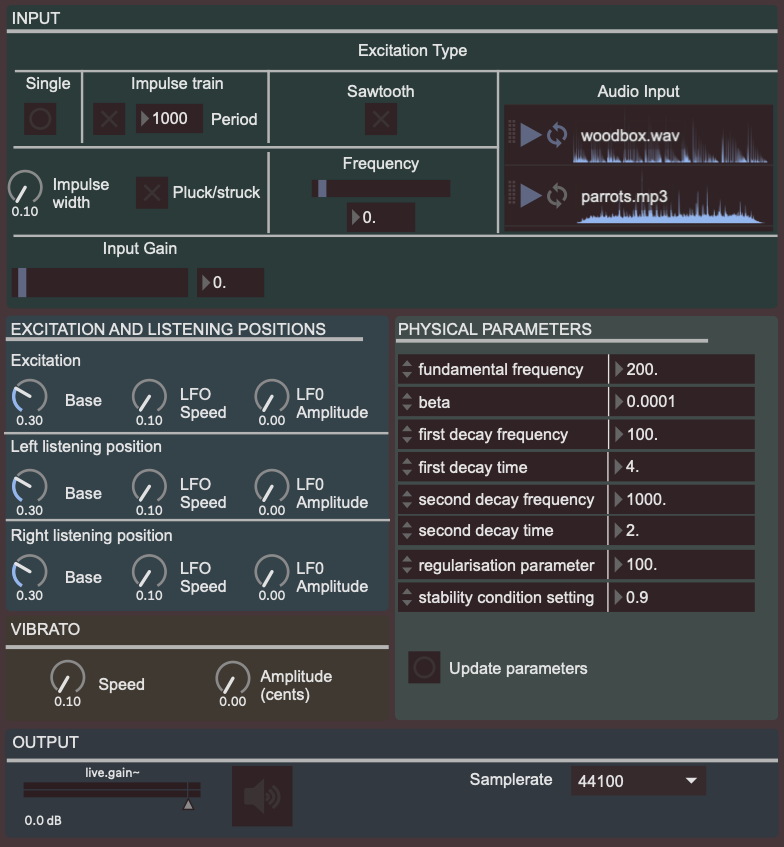
The interface is built around the object 1dSAV.CubicString (hidden in the presentation mode). The string is excited by a force, defined in the "Excitation type" section and applied pointwise at the Excitation position. The outputs signals correponds to the velocity of the string at two different points along the string. The pysical parameters of the string are defined through a set of higher level perceptive parameters (fundamental frequency, inharmonicity and decay times). The regularisation parameter and stability condition setting are parameters ffrom the algorithm which can be left as is in most of the cases.
Depending on the inharmonicity and decay time settings, sounds range from string-like to bell-like.
Polyphony for keyboard-like use
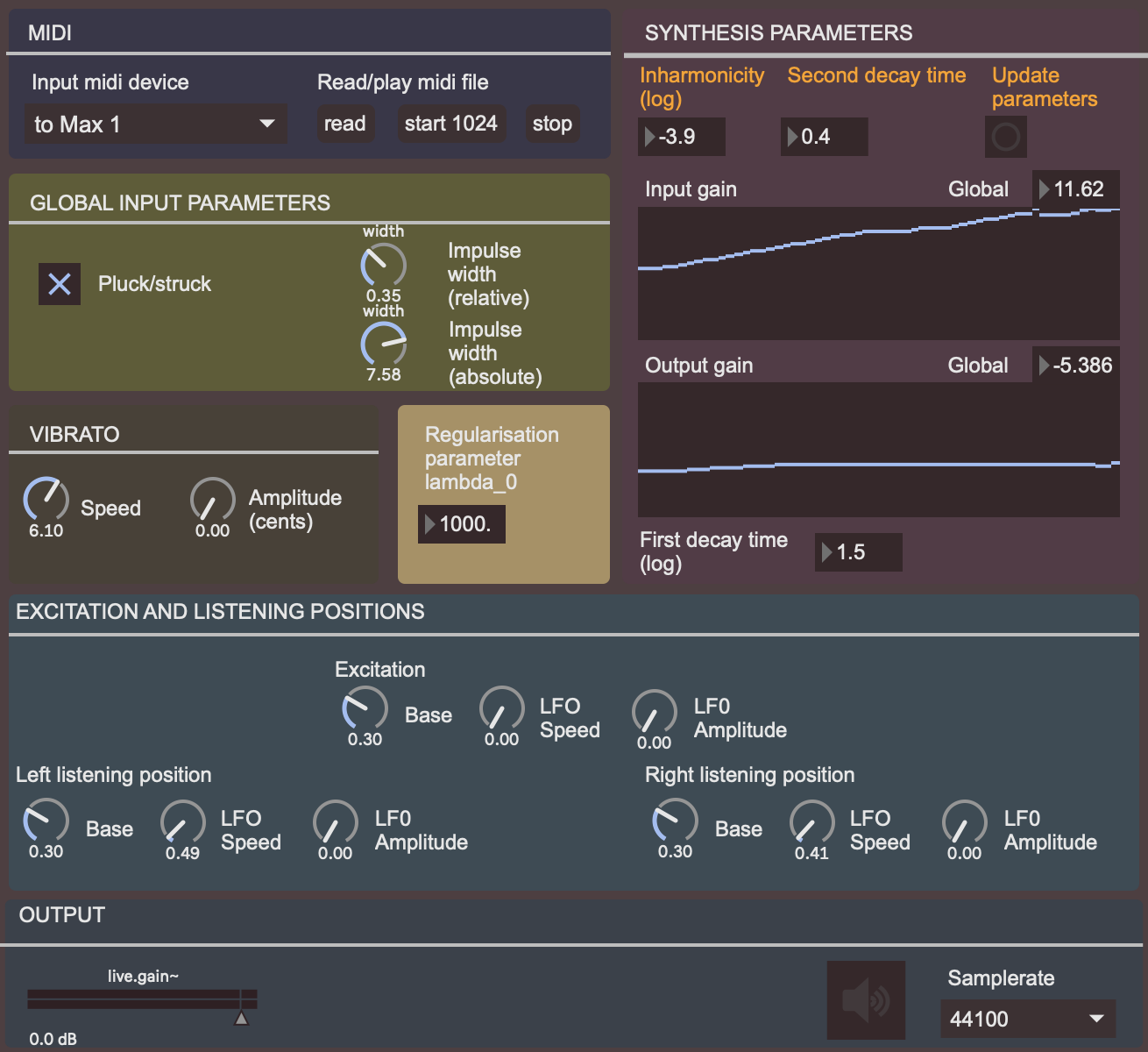
A polyphonic patch allows playing an ensemble of strings in a keyboard-like configuration.