Where There Is Singing, There You Will Settle Down by Caroline Vogel & Juice

➡️ This presentation is part of IRCAM Forum Workshops Paris / Enghien-les-Bains March 2026
Coral reefs are living soundscapes. Like human cities, they hum with constant activity: snapping shrimp crackle like static, fish produce rhythmic pulses, and waves refract through complex reef structures to create a dense acoustic environment. This polyphony is not incidental, as marine biologists and acoustic ecologists have found that reef sound plays a crucial role in guiding coral larvae and juvenile fish toward suitable habitats, acting as a multispecies signal of safety and vitality (Vermeij M. J. A et al., 2010; Radford et al., 2011). In this sense, reefs quite literally sing life into being.
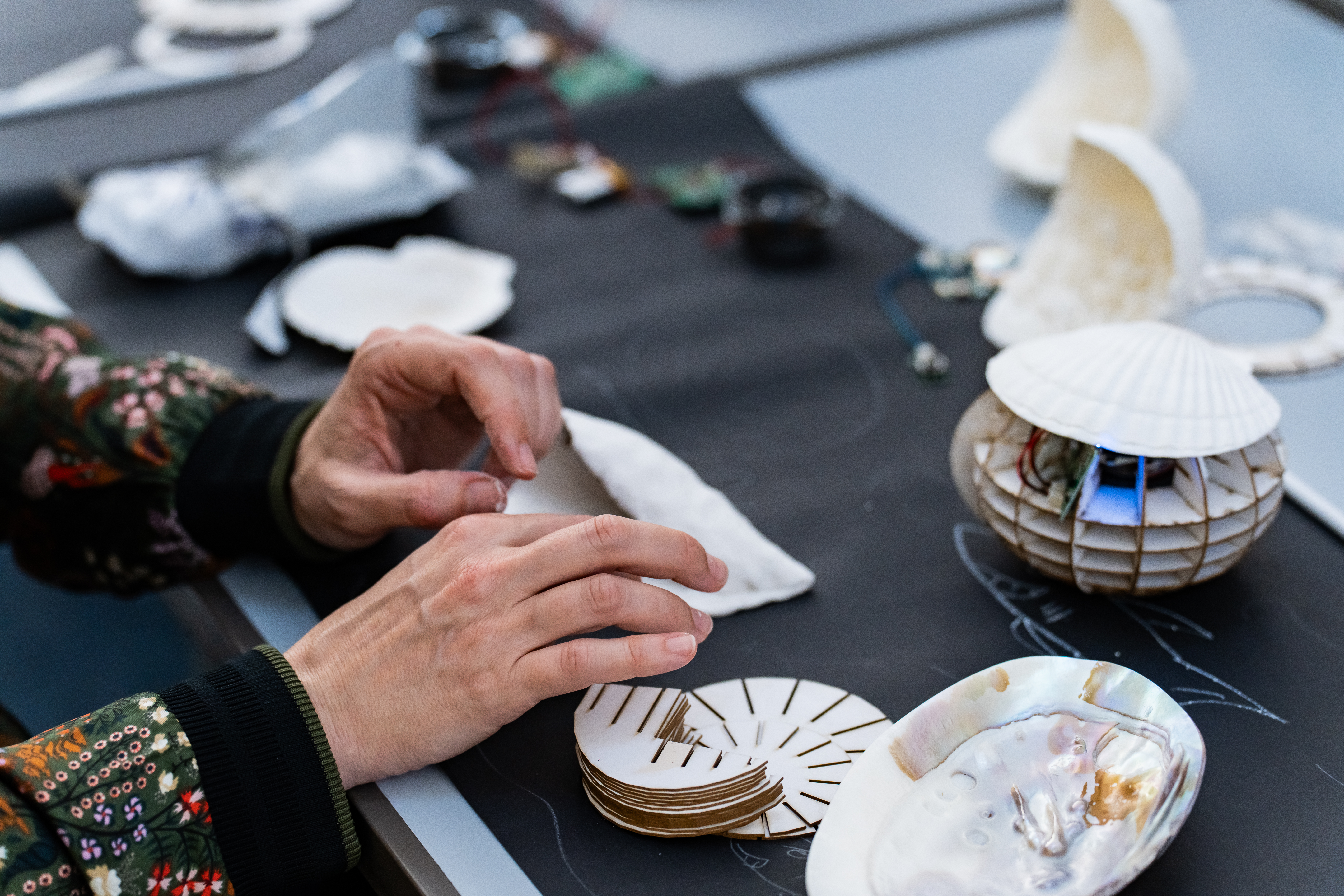
Where There Is Singing, There You Will Settle Down takes this ecological phenomenon as both material and metaphor. The multi-channel sound installation concludes a participatory workshop in which participants collectively mapped coral reef soundscapes through listening, speculation, and the co-creation of experimental instruments. The project approaches reefs as relational, acoustic systems defined by ongoing vibrational exchange.
Under the conditions of the climate crisis, ocean warming, acidification, and extractive human activity, coral reefs are rapidly losing both their biological diversity and their acoustic complexity. Degraded reefs become quieter, losing the sonic cues that attract new life and reinforcing cycles of ecological collapse (Gordon, 2020). Silence, here, is a symptom of systemic breakdown.
The project is informed by posthumanist and more-than-human thought that challenges the separation of humans from ecological systems. Drawing on Donna Haraway’s call to stay with the trouble (2016), the project resists solutions framed solely through technological optimism or managerial sustainability and cultivates practices of attunement: listening as an ethical act, and sound as a medium through which humans might re-enter damaged ecosystems as responsive, accountable participants rather than distant observers. Similarly, Anna Tsing’s notion of arts of noticing (2015) resonates within the work's methodology, which emphasizes slow listening, collective interpretation, and speculative making as ways of engaging with ecological complexity.
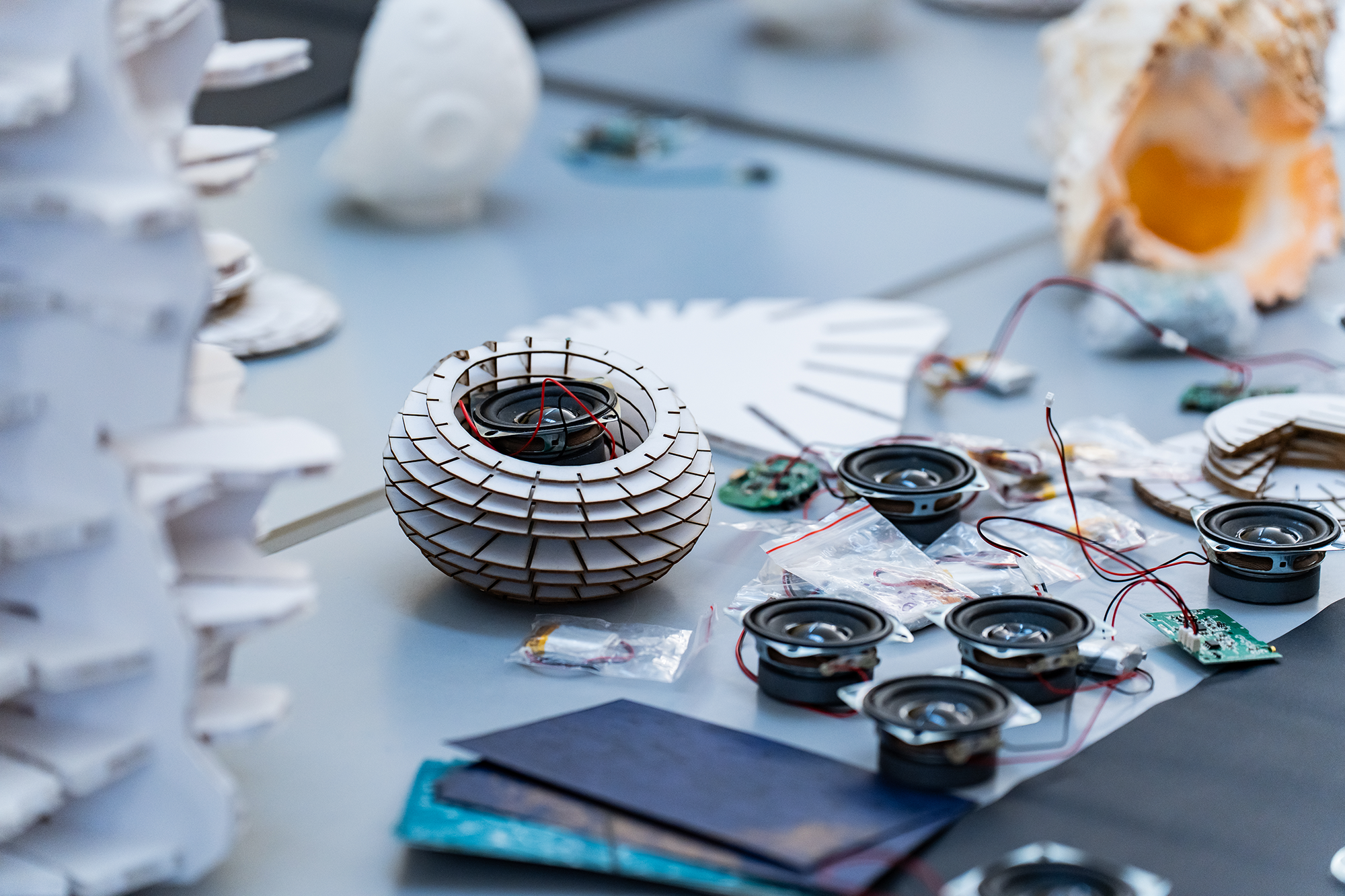
Through performative re-sounding, the installation unsettles binaries such as natural/artificial, human/nonhuman, and knowledge/practice. The co-created sounds and speculative instruments do not attempt to reproduce coral reefs, but rather to enter into a dialogue. These speculative instruments function as mediators and hybrid objects that sit between research tool, musical device, and storytelling apparatus.
The sound design of the project is a mixture of real coral reefs from archives and recordings, plus simulated coral reefs recorded using hydrophones through Max/MSP, plugins ASAP and GRM bundles, combined with sea recordings using binaural microphones. Pro Tools was used to construct a quadraphonic spatial audio experience. A custom-designed interface enables touch-sensitive interaction, allowing audiences to modulate and navigate the soundscape bodily rather than cognitively.
Gordon, T. A. C. (2020). The Changing Song of the Sea: Soundscapes as indicators and drivers of ecosystem transition on tropical coral reefs. Dissertations & Theses, University of Exeter.
Haraway, D. (2016). Staying with the Trouble: Making Kin in the Chthulucene. Duke University Press.
Tsing, A. L. (2015). The Mushroom at the End of the World. Princeton University Press.
Radford, C. A., Stanley, J. A., Simpson, S. D., & Jeffs, A. G. (2011). Juvenile coral reef fish use sound to locate habitats. Coral Reefs 30(2):295-305.
Vermeij M. J. A., Marhaver K. L., Huijbers C. M., Nagelkerken I., Simpson S. D. (2010). Coral Larvae Move toward Reef Sounds. PLoS ONE 5(5): e10660. https://doi.org/10.1371/journal.pone.0010660