Apollo e Marsia by Jonathan Impett (Orpheus Institute)

➡️ This presentation is part of IRCAM Forum Workshops Paris / Enghien-les-Bains March 2026
Apollo e Marsia addresses the fundamentally enacted, imaginative and contextual nature of musical memory, its constant reorganising of time, its internal loops and leaps of focus.
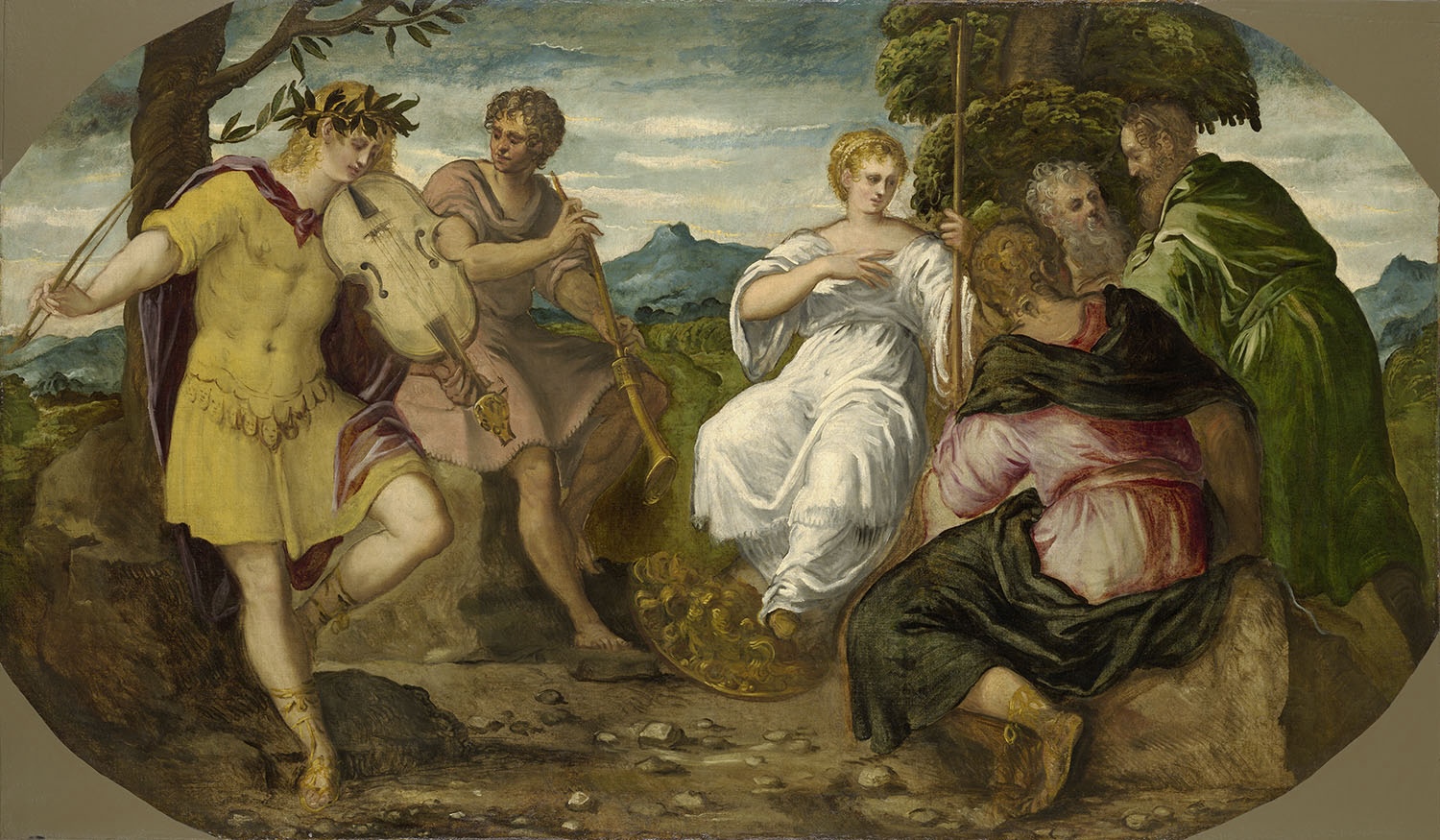
The image derives from a Tintoretto painting depicting Apollo and Marsyas in a contest to see which is the greater musician, as recounted by Ovid. We see the moment after they have finished playing but before the judgement; one will die. In this instant, both are remembering, reconstructing, reimagining their own performance and that of the other, their impressions and memories modulating each other into new formations. This installation thus deals with the generative, nonlinear memory of performance in compressed time and under stress.
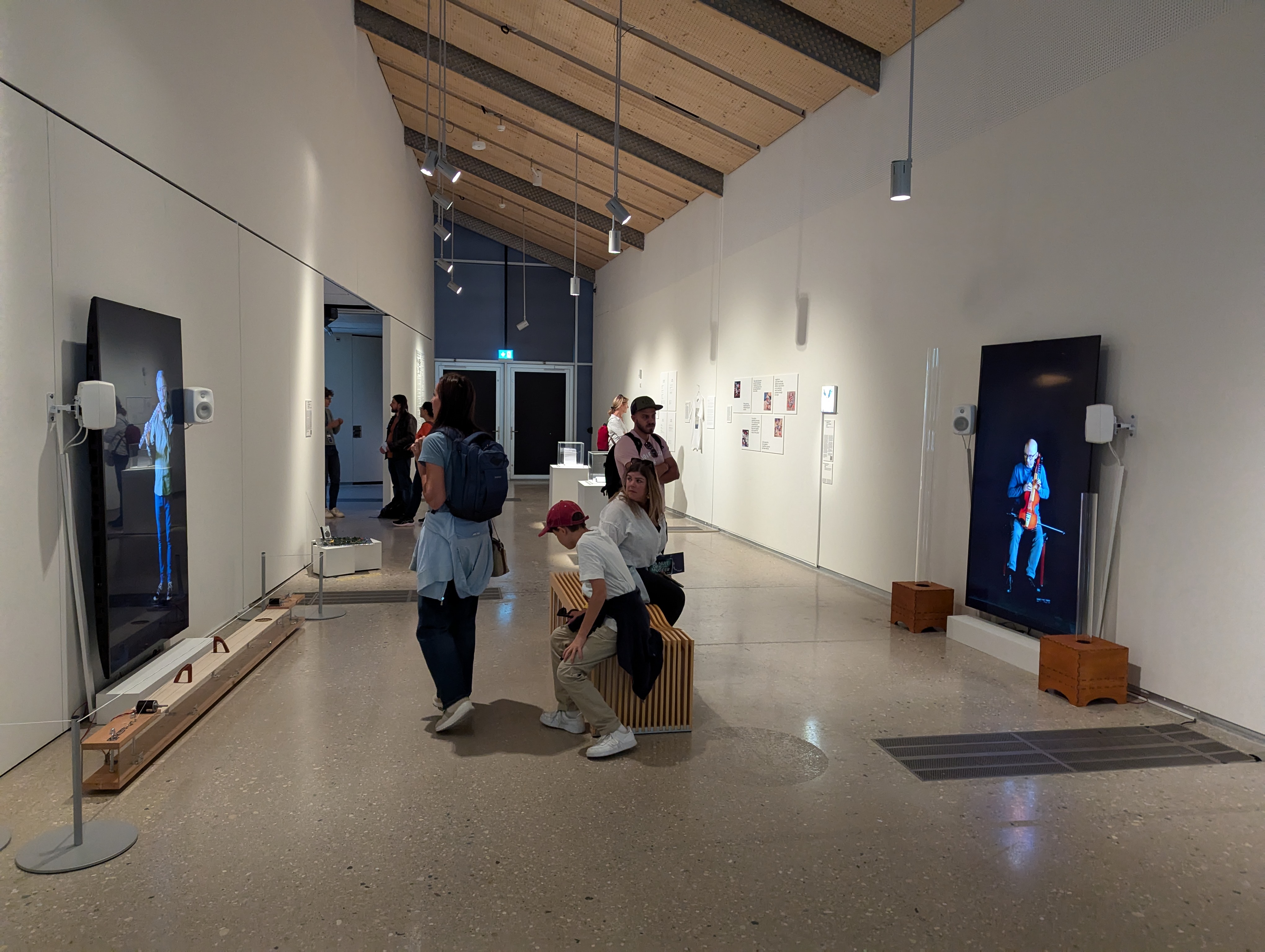
In its complete form, Apollo e Marsia is a hybrid installation consisting of two 85-inch screens, positioned opposite each other. One screen displays a filmed performance by a musician playing a viola d’amore, the other playing an alto flute, performances of roughly 23 and 25 minutes respectively. Each screen is surrounded by a pair of loudspeakers mounted at ear level, a microphone above the screen and a physical instrument. The speakers present the stereo live sound untreated. Two further channels of processed instrumental sound are played through large physical instruments: that of the viola d’amore through a vertical pair of long transparent acrylic tubes, that of the alto flute through a horizontal instrument, likewise transparent, with two 3-meter strings.
The musical material derives from two Delphic hymns to Apollo, subject to multiple layers of mediation. Wave models drive the generation of emergent material though iterative and nonlinear processes operating in both symbolic (Open Music) and sonic (Max) domains. Each performer hears themselves through the means of sound production of the other - the large physical instruments here simulated by filters. The memories of both performers are in constant evolution as AIs on each side listen to the whole in situ, responding through the physical instruments on the basis of impressions accumulated through each 24-hour period.