Forum Studio Session #5 : Blasé

Blasé
This fifth Forum Studio session is part of the CNM x Ircam Inside residencies, which aim to give artists and their professional entourage access to all the tools available at the Ircam Forum for live and studio technologies.

🔗 Check it out on YouTube
With his generous pop style, irresistible groove, and transatlantic influences, Blasé takes to the stage with his debut album BLABLABLA and its reissue. His conscious and daring inspirations are revealed in tracks such as “I Need It (from You),” recorded with the late Cola Boyy and a nod to the Bee Gees, and “Not Now,” where filtered house meets a disco-blues guitar riff and rap by Jwles and Valee. Author, composer, producer, and singer, Romain Hainaut aka Blasé is a French-American artist who navigates with disconcerting ease between old-school hip-hop, R&B, funk, jazz, and new wave. A languid voice that is never jaded, melodies that hit hard: 27 tracks — 27 slaps. (cf.Caramba)
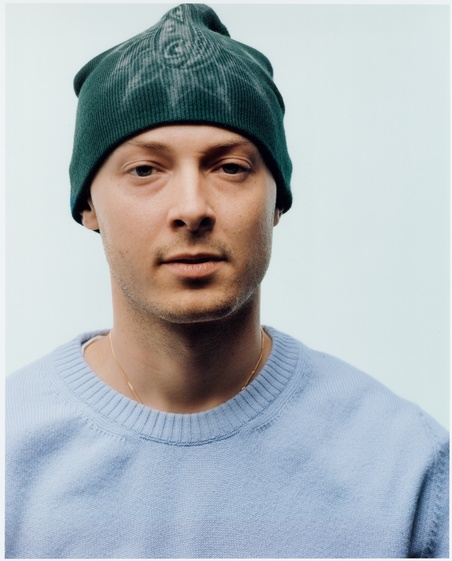
© Bureau_2A
Featuring: Rhythm Roulette, a live interactive performance.
The performance will be followed by a presentation of Soundworks technology developed at Ircam by the ISSM Team.
The performance will be followed by a presentation of Soundworks technology developed at Ircam by the ISSM team.
Rhythm Roulette is a modular musical environment for algorithmic composition and real-time performance, developed in HTML and web technologies. It allows users to instantly generate complete musical structures—rhythm, harmony, bass, and melody—and then gradually transform them through parametric adjustment.
The software can be used standalone as an autonomous instrument, or integrated with computer-assisted composition software. Its MIDI output can be routed to a DAW, hardware or analog instruments, or any device that accepts the MIDI protocol, making it suitable for both studio and live performance. The architecture is based on independent modules synchronized by a high-resolution central clock (tick system), operating internally or slaved to an external source via Web MIDI/MIDI, ensuring reliable time synchronization.
Rhythm Roulette offers a reversal of the traditional composition process: rather than building a piece by accumulation, the user immediately generates an overall musical form, which they then refine in real time by modifying parameters such as rhythmic density and style, event probabilities, temporal placement, register, legato, or harmonic complexity.
The generation strategies are directly derived from my composition process and formalize fundamental musical parameters aimed at achieving simple and effective results. The rhythmic module is based on probability tables organized into style presets, which can be modified in real time, producing coherent variations without freezing the patterns. The harmonic and melodic modules are musically constrained: the notes generated respect tonality and chords, ensuring overall consistency while allowing for controlled variation. The interface, deliberately minimalist, is designed as an instrumental control surface, encouraging listening, improvisation, and performance.
Bio Blasé:
Blasé is a French-American pop artist. A composer, arranger, producer, singer, and songwriter, he began playing music at the age of nine with the saxophone, then composed his first songs on GarageBand on his parents' computer. Since his childhood and adolescence in New York, he has been experimenting, mixing 70s rock, electronic music, disco, and hip-hop to create a sound that would eventually take him to Paris with his first band Haute (accompanied by Anna Majidson) and his first hit “Shut Me Down,” whose live Colors session is one of the most viewed on the platform to date.
Building on this initial success, Blasé toured abroad, produced and composed for others (Jwles, DJ Pone, Agoria, Lala &ce, etc.) and became the go-to man whose solo album everyone dreamed of hearing one day. In 2025, he released his first album, “BLABLABLA,” which stands as a personal manifesto of his musical obsessions, opening up almost as many avenues. But there's no question of taking them at full speed or in the wrong direction, at the risk of collisions and crumpled metal. “BLABLABLA” imposes a flow that respects the rules of conduct in the sense of a quest for a common groove. Thanks to his ears trained on radio stations and charts from across the Atlantic, he honors this generous vision of pop that encompasses old-school hip-hop, R&B, jazz, funk, disco, and new wave. Navigating between different styles in the manner of American artists is not even up for debate. Thus, on “BLABLABLA,” we move from a studio haunted by Quincy Jones to a basement where The Cure rehearses “Boys Don't Cry”...