Liminal: A Human–AI Interaction Space Between Control and Autonomy by Zhitao Lin

➡️ This presentation is part of IRCAM Forum Workshops Paris / Enghien-les-Bains March 2026
Liminal is an interactive audiovisual installation that explores a specific interaction space between human participants and an AI-driven system. Rather than positioning the human as a controller or the AI as an autonomous generator, the work investigates what happens in the intermediate state where agency is shared, negotiated, and continuously reconfigured over time.
Many contemporary interactive music and media systems rely on explicit gesture-to-parameter mappings, producing immediate and predictable responses. In such models, interaction is framed as control, and the system functions as an instrument. Conversely, fully autonomous AI systems minimize human influence, framing the machine as an independent creator. Liminal is situated deliberately between these two paradigms, proposing interaction as an evolving process rather than a sequence of commands or automated outputs.
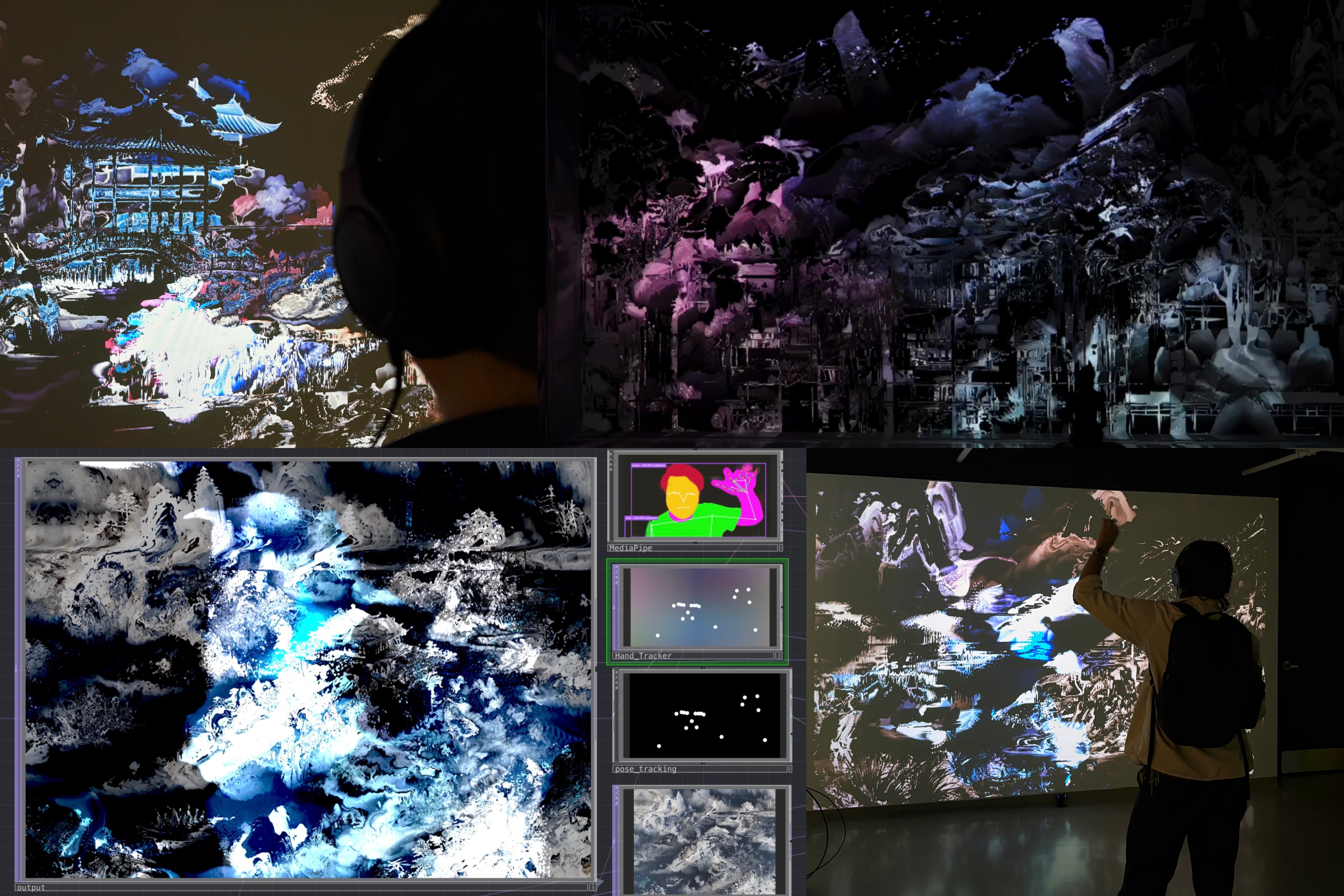
Defining the Liminal Interaction Space
In this project, liminal refers neither to a metaphor nor to a poetic abstraction. It designates a concrete interaction state and operational space between human input and AI behavior. Within this space, neither the human nor the machine fully determines the outcome of the interaction. Instead, audiovisual results emerge through continuous negotiation across time.
Human gestures are not treated as instructions. Likewise, the AI system does not act independently of human presence. Gestural input functions as contextual information that influences the system’s internal decision-making processes without dictating them. The system, in turn, maintains its own temporal coherence and behavioral continuity, responding to human presence while preserving structural autonomy.
This liminal state exists precisely because the system resists collapsing into either direct control or full automation. Interaction unfolds through gradual modulation, accumulation, and transformation, rather than instantaneous cause-and-effect relationships.
Liminality as a Temporal Condition
A defining characteristic of the liminal interaction space in Liminal is its dependence on time. Gestures do not produce immediate outcomes; instead, they influence probabilities, tendencies, and trajectories that unfold across extended durations. The system incorporates temporal memory and decay mechanisms, allowing past interactions to shape future behavior without fixing results.
This temporal structure shifts participation from momentary intervention to sustained engagement. Participants learn that influence is cumulative and indirect, encouraging attentive listening and adaptive movement rather than exploratory triggering. Interaction becomes a process of shaping conditions rather than producing events.
System Architecture and Interaction Design
The system is implemented as a real-time interactive engine connecting gesture perception, decision-making processes, and audiovisual synthesis within a continuous feedback loop.
Gesture data is captured through computer vision–based analysis and processed into higher-level descriptors such as spatial distribution, motion continuity, velocity, and pause duration. These descriptors are interpreted as behavioral tendencies rather than discrete control values.
A decision layer implemented in Python mediates between gestural tendencies and generative processes. This layer applies probabilistic weighting, temporal smoothing, and internal state tracking to ensure that interaction remains gradual and coherent over time. The system retains memory of prior states while allowing influence to decay, preventing abrupt shifts and preserving continuity.
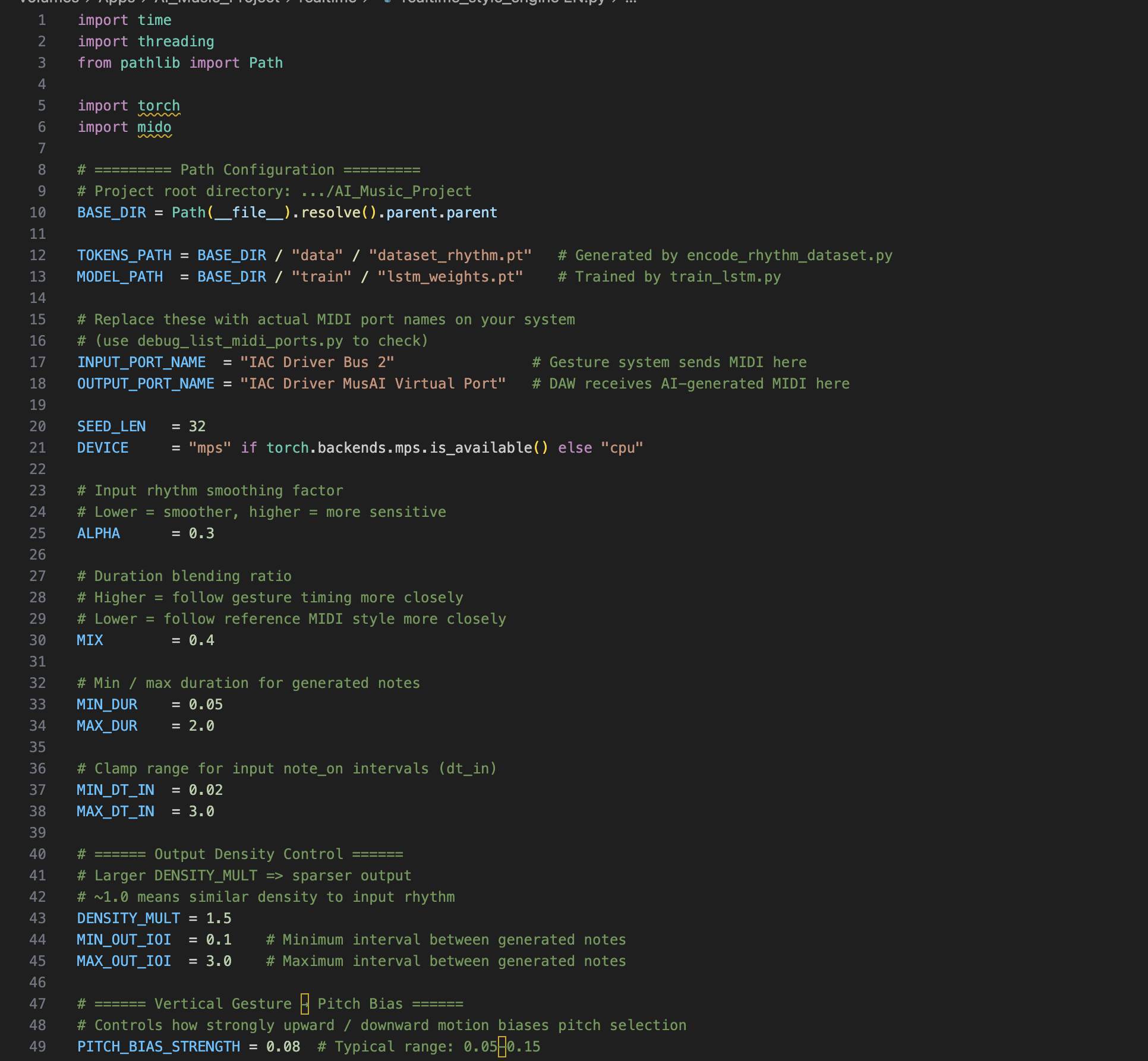
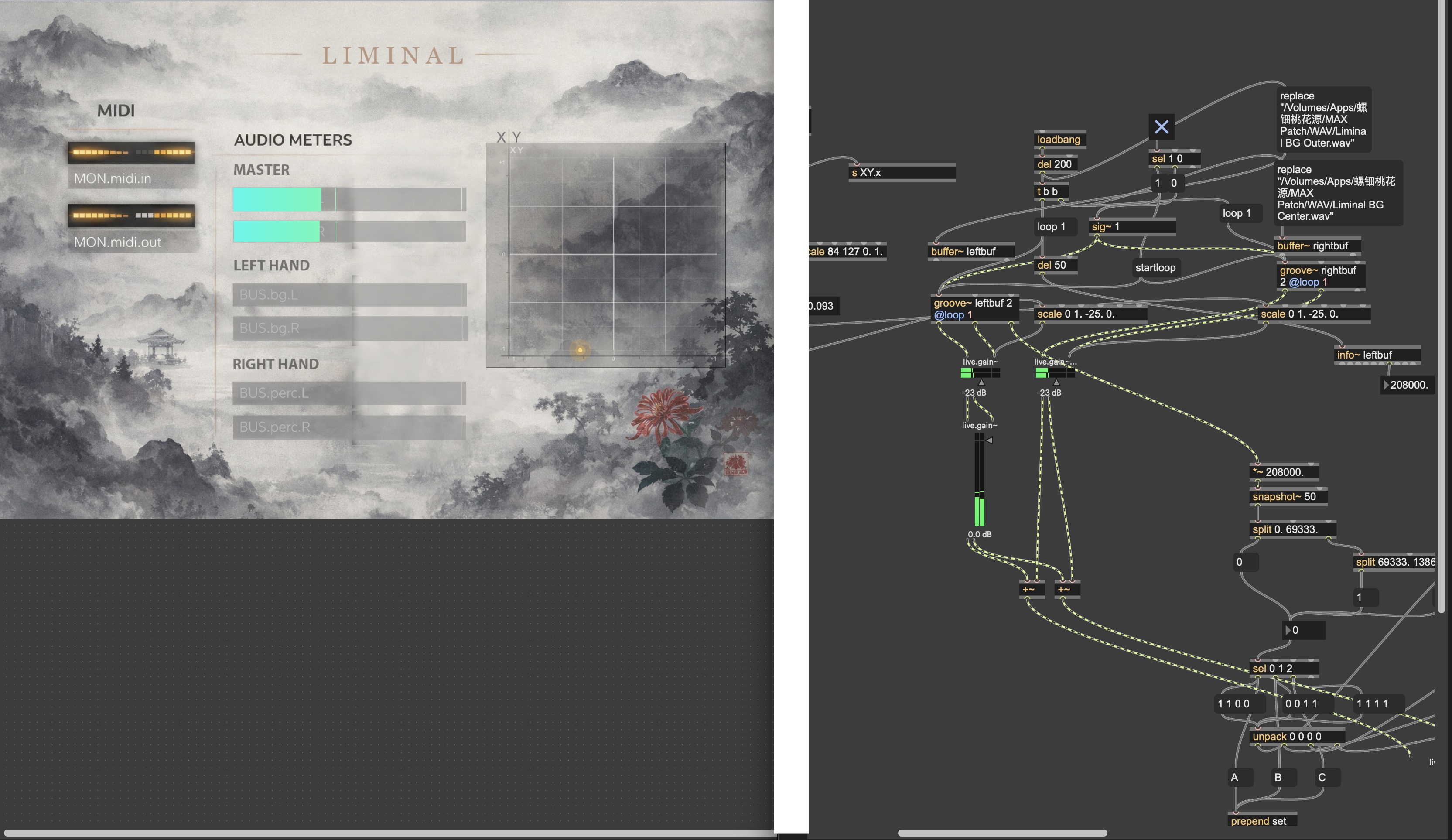
On the audio side, these evolving interaction states modulate generative music processes within a modular Max/MSP environment. Musical density, timbral emphasis, and spatial behavior are reshaped continuously, while the system maintains its own internal musical logic. Sound diffusion emphasizes spatial perception, reinforcing the embodied nature of interaction.
Visual generation operates in parallel through a real-time generative pipeline. Interaction states influence transformation processes rather than triggering discrete images, resulting in continuously evolving ink-wash–inspired visuals combined with iridescent textural elements. Audio and visual modalities are synchronized at the level of interaction state rather than event-based triggering, allowing them to co-evolve as parts of a unified system.
Distributed Agency Between Human and AI
Within the liminal interaction space, agency is distributed rather than centralized. Decision-making emerges from the interaction of multiple layers: human movement, gesture interpretation, probabilistic modeling, and audiovisual synthesis. No single layer fully governs the outcome.
This distribution prevents both human dominance and machine autonomy. The human influences the system without being able to predict or control it fully. The AI system maintains behavioral coherence without asserting independence. Authorship is therefore continuously deferred, existing neither in the participant nor in the machine, but in the evolving interaction between them.
Presentation Context and Observations
Liminal is presented as an open installation in which participants may enter and leave freely. Individual and collective interactions produce distinct audiovisual dynamics, revealing how the system responds differently to varied patterns of presence and movement.
Across presentations, participants often transition from exploratory gestures toward more restrained and attentive actions. This behavioral shift reflects an understanding that influence operates over time rather than through immediate feedback. Each realization of the work develops differently, shaped by accumulated interaction histories rather than predefined scenarios.
Questions Raised by Liminal Interaction
The project raises broader questions relevant to interactive and AI-driven art practices:
-
How can interaction be designed without defaulting to control-based paradigms?
-
What forms of authorship emerge when outcomes are temporally negotiated rather than directly triggered?
-
How can AI systems participate in creative processes without imitating or replacing human expression?
By framing interaction as a liminal space between human intention and machine process, Liminal offers a practical model for addressing these questions through system design rather than conceptual abstraction.
Conclusion
Liminal proposes a model of human–AI co-creation grounded in a clearly defined intermediate interaction space. By resisting both direct control and full automation, the work establishes interaction as a shared temporal process shaped by continuous negotiation. This approach offers an alternative framework for designing interactive systems in which humans and machines coexist as co-actors within an evolving creative environment.