OVERTON 3D audio synthesizer by Martin Antiphon

➡️ This presentation is part of IRCAM Forum Workshops Paris / Enghien-les-Bains March 2026
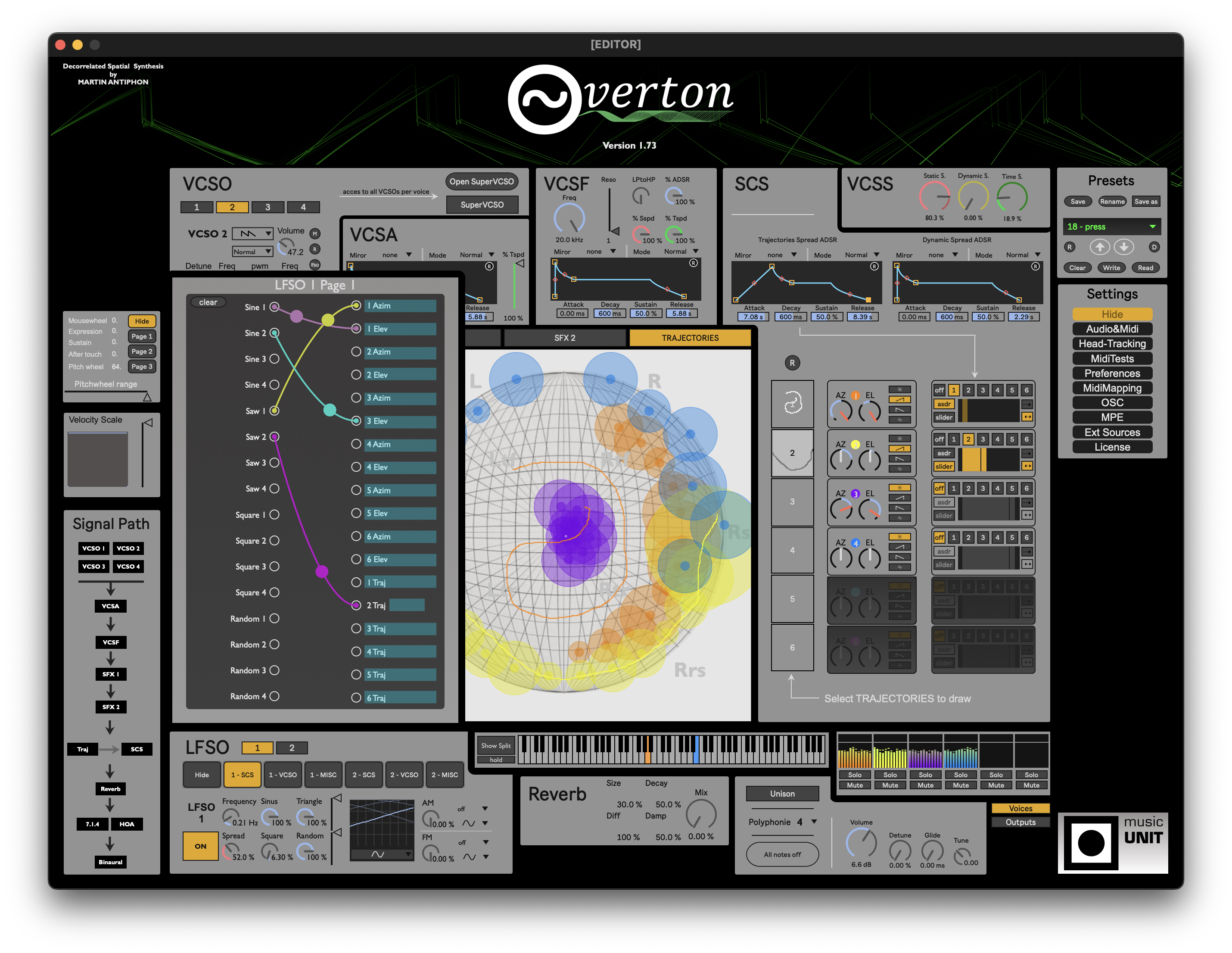
Overton is a three-dimensional audio synthesizer inspired by classic sound synthesis architectures. It is primarily based on additive and substractive synthesis principles, a set of traditional modulations, all integrated into an advanced spatialization engine.
Overton's central feature uses Decorrelated Spatial Synthesis. Each polyphonic voice consists of several independent voices (called instances to avoid confusion with polyphonic voices), each incorporating a complete signal path including an oscillator, filter, amplifier, and a coordinate generator. A decorrelation engine acts on these instances using high-level controls, taking into account their position in space. This architecture makes it possible to generate not just point sources of sound, but textures occupying extended areas of three-dimensional space.
The use of modulations and controls familiar to traditional synthesizers allows the sound space to be sculpted intuitively. Low-frequency generators, themselves composed of several decorrelated instances, can simultaneously control synthesis parameters—such as amplitude or frequency modulation—and spatial parameters. This results in a close relationship between the characteristics of sounds and their placement in space. When these modulations are applied to different instances of a single polyphony voice, they produce unique soundscapes: rhythmic patterns with long wavelengths, and denser, more textured structures at higher frequencies.
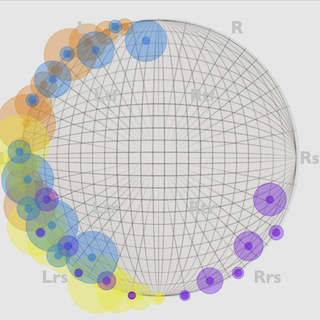
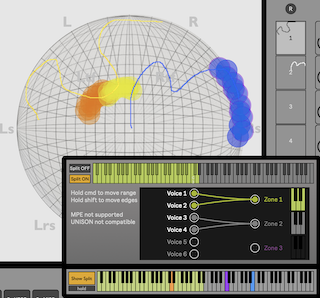
Overton also includes a trajectory generator, which can be controlled either manually, by modulation sources, or by an envelope generator. These trajectories can be assigned individually to each polyphonic voice. Combined with classic functions such as keyboard split, this feature allows certain note ranges to be applied in specific spatial functions.
The synthesizer also offers standard features such as preset management and export, MIDI mapping, and full parameter control via OSC. Additional control devices—expression wheel and pedal, as well as support for certain MPE features—offer extended interaction possibilities.
Overton was developed as a standalone Max application. Rendering is performed whith SPAT and natively offers binaural, 7.1.4 and 4th order ambisonic outputs. It is currently being rewritten to be released as a VST plug-in.